High-Agency Leadership
“Leadership Development” Doesn’t Exist
Why many AEC firms want the wall but never invest in the bricks
A project manager comes back from a two-day leadership seminar with a binder and a few good ideas. A month later the binder is on a shelf, and nothing about how she runs her projects has changed. Her team noticed. So did she.
That’s the real cost of most leadership development. It isn’t the registration fee or the lost billable hours. It’s what the experience teaches people.
For any talent development effort to work, two beliefs have to be in place. The firm and its leaders have to believe people can improve: that they can get better and perform at a higher level. And more important, the staff have to believe it too. They have to believe they can learn, and that the next program, seminar, or conference won’t be one more giant waste of time.
Every initiative that changes nothing chips away at both. Owners conclude that leadership can’t really be taught. Staff conclude it’s another box to check. After enough of that, even a good program fails, because nobody walks in expecting it to work.
So here’s my claim: leadership development doesn’t exist. Not as a standalone thing you can buy, schedule, and check off. Firms want the wall (better leaders, a higher-performing firm) but rarely invest in the bricks that build it.
Losing the forest for the trees
Why does this keep happening? Part of the problem is that most firms lack a cohesive model of talent development: how people actually learn, and how they actually change. Without one, “leadership development” becomes a string of disconnected events. A workshop here, a conference there, an assessment nobody revisits.
In the middle of all that activity, we lose the forest for the trees. Leadership development, talent development, coaching, training: none of it is the goal. It’s all a means to an end.
The end is a higher-performing firm.
Start with the work, not the program
Here’s where most efforts lose people. The fastest path to credibility is displaying common sense, and almost nobody finds it common sense that a one-off program will make someone a better leader. What people can believe in is a model that paints the path to get there: one that reveals what they already know to be true about how work gets done and how people grow.
That model starts with what the firm actually is.
A firm is made up of roles. Studio principal, project manager, discipline lead, project engineer or architect, business developer, operations manager.
Those roles carry out core processes. For example:
- Winning work: pursuits, proposals, client relationships
- Delivering projects: planning, staffing, scope, schedule, quality
- Managing resources: workload, priorities, utilization
- Building the team: hiring, onboarding, feedback, development
- Running the business: financial performance, strategy, decisions
Each process breaks down into tasks. Delivering a project means running a kickoff, delegating work, reviewing a junior engineer’s calcs, handling a scope-change conversation with a client, and resolving friction between disciplines. Map a single role like studio principal and you’ll find close to 50 distinct tasks, from setting the studio’s targets to resolving escalated client, project, and personnel issues.
Look closely at that list and you’ll notice something. Many of those tasks are what we usually call “leadership.” Leadership isn’t a separate subject. It’s woven through the work.
Why recipes don’t work
Once firms identify those tasks, the usual next move is to teach them as recipes. Here’s how to run a meeting. Here’s the five-step delegation model. Here’s the feedback script.
There are two problems with that.
First, the tasks never look quite the same twice. Every client, project, and team member is different, so people have to adjust on the fly. A recipe breaks the moment the situation doesn’t match it.
Second, and more important, recipes skip the underlying capabilities that make someone good at the task in the first place. Those capabilities are the bricks:
- Self-management: knowing one’s own aptitudes, personality, worldview, and innate needs, and how they help or get in the way
- Soft skills: self-regulation, empathy, and communication
- Hard skills: problem solving, planning, forecasting, and written communication
- Domain knowledge: for leadership tasks, less about buildings and more about people and the business
- Credentials: the licenses and certifications some tasks require
- Organization-specific info: decision rights, policies, metrics, and how this firm really works
Take one task: resolving an escalated client, project, or personnel issue. The recipe says gather the facts, decide, and follow through. Whether that works depends on the bricks underneath. Does the principal know which issues they have the authority to settle, and when counsel or the insurer has to be told? Do they understand what a write-off or a lost key person really costs, and how contracts and employment law limit what can be said? Can they piece together every party’s account, price each option, and put the decision in writing without conceding liability the firm doesn’t bear? Can they stay steady with an angry client and deliver an unwelcome decision plainly? And do they know their own tendencies, whether that’s smoothing things over or promising a fix before checking the contract?
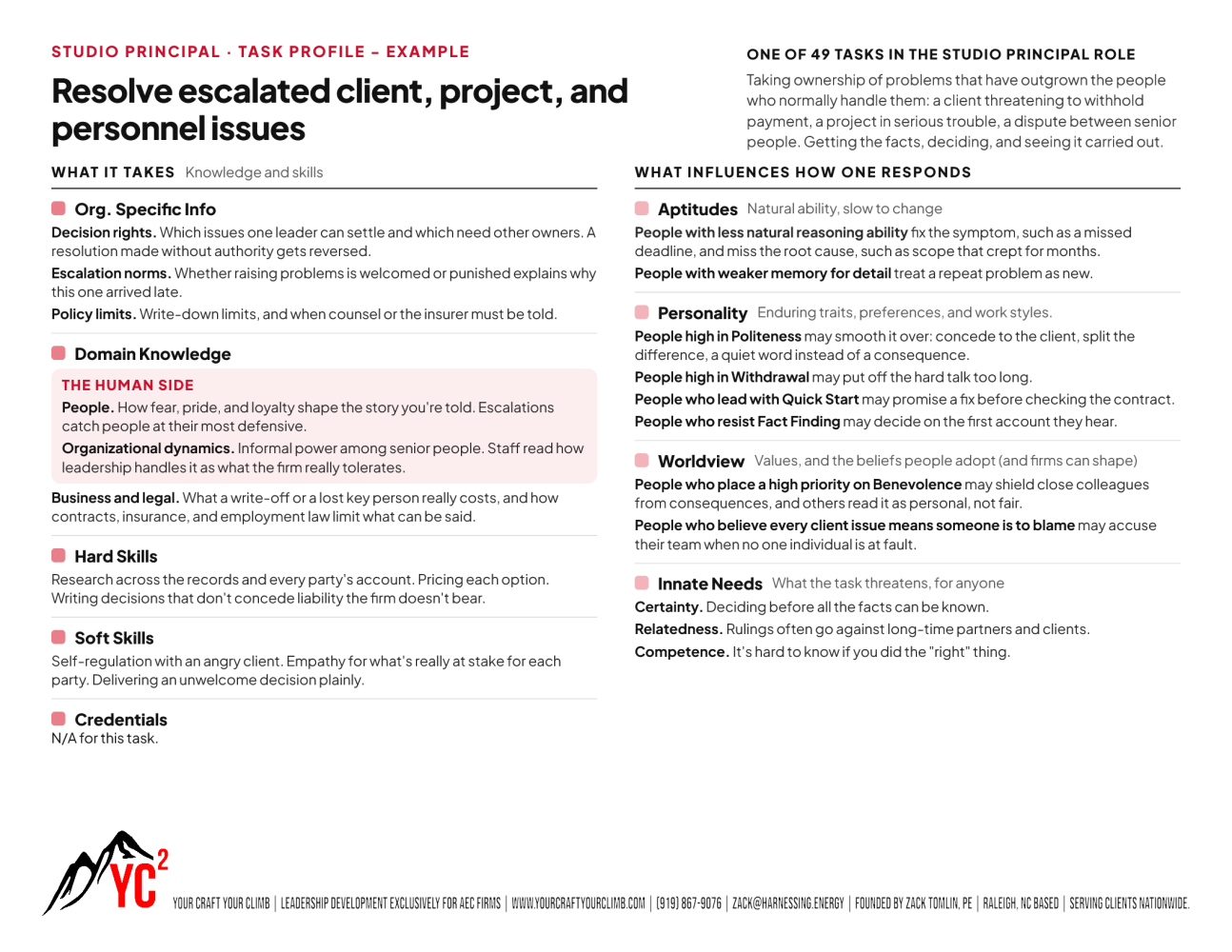
Someone with the right bricks in place can handle a task they’ve never seen before. Someone who only learned the recipe can’t.
That’s what I mean when I say leadership development doesn’t exist. There’s no single thing called “leadership” to develop. What we can improve is people’s ability to complete the tasks we associate with leadership. We do that by understanding exactly what those tasks are, and the bricks that go into them.
Building the wall
Only when you can see the roles, the processes, the tasks, and the bricks behind them does it make sense to design a development plan. At that point you know what you’re building, and why.
It also tells you how each brick gets built. Some come through self-mastery: understanding how you’re wired. Some come through instruction and practice. And some, like much of the organization-specific info, belong in the firm’s systems and processes rather than in anyone’s memory.
Your curriculum now has a job, whether you build it internally or buy it from an outside provider. Each program, coaching engagement, or stretch assignment is a brick placed on purpose. Together they build the wall: more capable people, stronger leaders, and a higher-performing firm.
Without a plan, you’re just piling up bricks (a seminar here, a conference there) and hoping a wall emerges on its own. It never does.
Leadership development doesn’t exist on its own. It exists only as bricks in a wall you’ve designed. Built that way, it does something a binder on a shelf never will: it shows your people, and your leaders, that getting better here is real.
So where does your firm start: with the program, or with the work?
I’m Zack Tomlin, former AEC firm owner and founder of Your Craft Your Climb. I work with AEC firms and their staff to develop their most valuable asset: their people—and the organization that supports them. Learn more about working with Zack.
Further Reading